
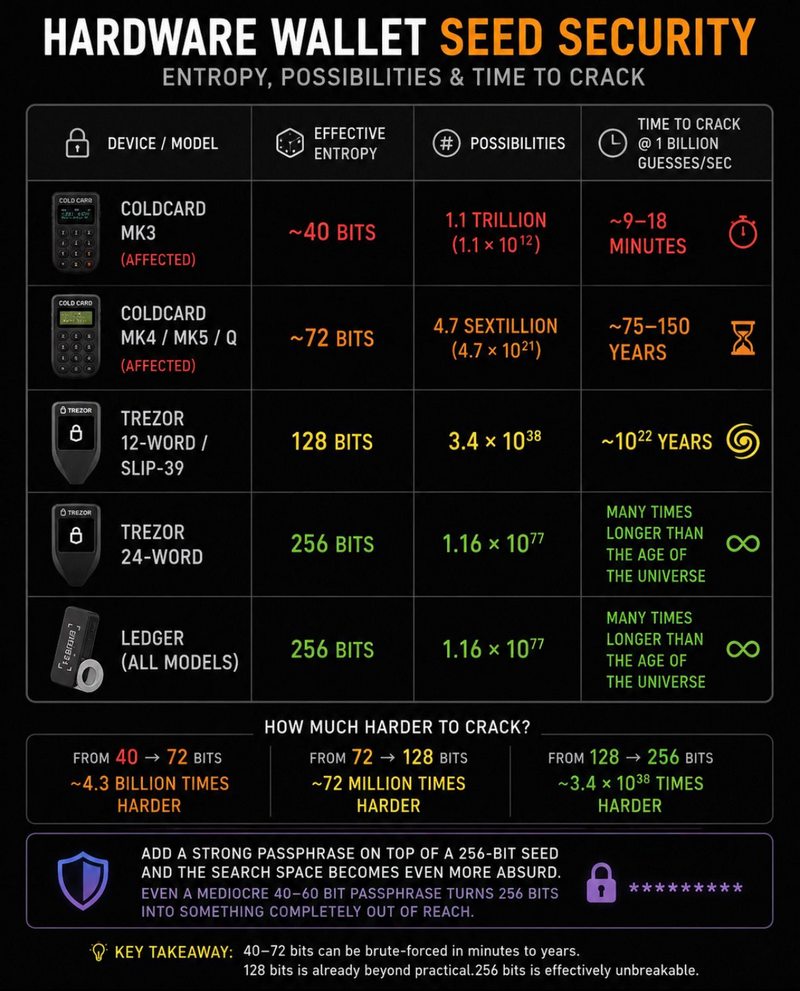
The case of ColdCard wallet worked because the implementation was
broken (radically reduced entropy). It wasn't the cryptography that
failed, it was a software engineering bug Brute-force remains
mathematically impossible
In 2020, after a competing device used Coldcard's then-GPL code,
Coinkite switched to a more restrictive MIT + Commons Clause
license. On March 1, 2021, a large “First pass w/ libNgU” commit
removed remaining GPL code and, in the process, disabled the hardware
random number generator.
Firmware fell back to a weak software RNG (Yasmarang), sharply reducing
entropy for new wallet seeds on affected devices. The flaw
remained undetected for years until attackers began sweeping vulnerable
addresses in late July 2026, moving well over 1,000 BTC.
Weak random number generation is not a new problem. RNG
vulnerabilities have previously been found in:
bip3x Python library
bitaddress.org
BitcoinSpinner
Blockchain.com Android wallet
Blockchain.com web wallet
brainwallet.org browser generator
Cake Wallet
CoinPunk
COLDCARD Mk2 – Mk5 & Q
Ethereum presale wallet generator
Libbitcoin Explorer (bx seed)
Mycelium Bitcoin Wallet
PHPCoinAddress
Profanity
QuickCoin
Schildbach Bitcoin Wallet for Android
Trust Wallet browser extension
Trust Wallet for iOS
A detailed timeline is circulating that reconstructs how the Coldcard
seed vulnerability was introduced and later exploited:
-->? July 2020
- Foundation Devices releases Passport by copying the Coldcard firmware
(then under free GPL license)
- NVK publicly regrets choosing the GPL: "now we have a clone"
-->? Late 2020 early 2021
- Coinkite changes the license
- Switch to MIT + Commons Clause: you can read the code, but you no
longer have the right to use it to make a competing product
- Goal: kill commercial copies
-->? March 1, 2021
- Massive commit of 120 files "First pass w/ libNgU"
- We remove the last GPL-licensed code sections
- It's exactly in this commit that the bug is introduced
- The hardware random number generator (TRNG) is bypassed
- The firmware silently switches to a predictable software generator
(Yasmarang)
- Result: instead of 128 bits of entropy, we drop to about 40 bits on
Coldcard Mk3... That's weak. Very weak
-->? 2021 to 2026
- The bug remains "invisible" for 5 years
- The new restrictive license has sharply reduced the number of people
motivated to deeply audit the code
- Fewer eyes = the bug survives!
-->? The arrival of AI changes the game
- Coinkite itself runs its firmware through "one of the best AI models"
a few weeks before the attack, and the model finds nothing!
- The attacker certainly used an LLM (or several) to scan old versions
of the open-source code and spotted the subtle bug that even Coinkite's
AI had missed ?
-->? April-May 2026
- The biggest addresses that will be drained in July receive tiny
amounts of bitcoin (dust)
- This isn't random. It's target marking
- The attacker already had the list of vulnerable seeds at least three
months earlier
-->? July 30, 2026
- Between 01:10 and 01:51 UTC, over 1080 BTC leaves 1,196 addresses
- Three days later, the total exceeds 1367 BTC from 4,585 addresses
- The funds are consolidated to a few addresses... and almost nothing
moves afterward
- Recognizable transaction signatures: fixed fees at 30 sat/vB, no
change output, batched sends
-->? The attacker's only real mistake
- During the operation, he used a paid account with a major blockchain
data provider
- The logs match down to the second
- The provider wasn't complicit, but it has logs and probably KYC...
That's the best lead for the authorities
-->? Why July 30?
- The stock of vulnerable seeds with dormant funds was at its maximum
- We were just days from the start of the critical BIP-110 window (the
anti-Ordinals soft fork)
- The entire hardcore community's attention (exactly the Coldcard
audience) was already saturated!
-- Who's responsible for what?
- Coinkite: changed the license to protect itself commercially, and
introduced the bug in the same move
- The attacker: showed rare patience, prepared his strike for months
(or even years), and executed it almost perfectly
- The community: trusted "open-source" and a hardware wallet without
ever really checking how the randomness was generated!
-- The lesson:
- Dice rolls + passphrase are not optional
- "Open-source" doesn't mean "audited"
- A license that's too restrictive can kill audits
- AI radically changes the power dynamic: a subtle bug can stay hidden
for 5 years... until a model finds it in one night or faster!
- An attacker with time almost always beats a community that's too
trusting!
So here's what I'd recommend to developers: use AI, have your source
code reviewed, and then have an experienced software engineer go over
the whole thing again—in other words, a senior engineer plus AI. In my
opinion, that's the ideal combination right now. It scares me a
little to think how many similar products with bugs are out there on
the market (and it's not necessarily just crypto wallets). Everyone is
just looking for a quick way to make money (a trend in the U.S.), but
the actual hard work of design and programming is really starting to be
noticeably lacking here. I was a programmer throughout the 1990s, so
trust me, I know what I'm talking about.
Written by Radoslav Krehlik -
[email protected]
 Updated:10:41 AM CEST Aug,04
(new)
Updated:10:41 AM CEST Aug,04
(new)


 Add your comment (free registration required)