 Updated:06:56 PM CET Oct,25
(new) 
(c) 1998-2026 Gameguru Mania
Privacy Policy statement
|
Modders Unlock Up to 2x Tensor Speed on RTX 30 and 40 Series - tech|
| (hx) 05:51 PM CET - Oct,25 2026 | 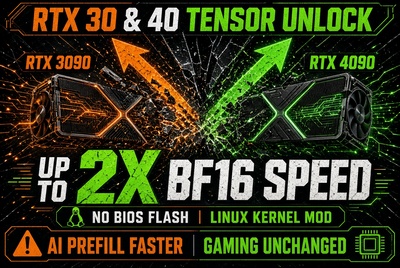
Verified open-source tools remove artificial FP16/BF16 limits on
GeForce cards - October 2026
Enthusiasts have released open-source tools that remove NVIDIA’s
artificial limit on FP16 and BF16 Tensor Core performance on GeForce
RTX 30 and 40 series cards. The unlock needs no BIOS flash and no
permanent driver changes. A Linux kernel module runs before the
official driver loads, adjusts hardware speed selectors, and then lets
the normal driver take over. Results so far are preliminary and mainly
tested on Linux.
On an RTX 3090 Ti, BF16 matrix performance rose from 87.5 to 157.4
TFLOPS (about +80%). An RTX 4090 went from roughly 165.5 to 330.6
TFLOPS in BF16, nearly doubling. Real-world AI tests show faster prompt
processing and some image-generation workloads (roughly 14–36% or
higher in reported cases). Token generation speed usually stays about
the same because it is often limited by memory bandwidth rather than
pure compute. Gaming performance is not expected to improve.
Reported Results (GEMM / Tensor Tests)
| Card |
Precision |
Before |
After |
Gain |
| RTX 3090 Ti |
BF16 |
87.5 TFLOPS |
157.4 TFLOPS |
~+80% |
| RTX 3090 |
BF16 |
— |
— |
up to +67% |
| RTX 3070 |
BF16 |
— |
— |
up to +81% |
| RTX 4090 |
BF16 |
165.5 TFLOPS |
330.6 TFLOPS |
~2× |
Projects (Download / Source)
Note: These projects are new and experimental. Support
varies by exact card, and a Windows path is still limited or
experimental. Always check the GitHub pages for the latest
instructions, compatibility, and risks. NVIDIA has not officially
supported or endorsed the method.
Sources
Ed.note: The Ampere limit is a pair of volatile speed selectors, not a setting stored in the VBIOS. The working method writes them from a Linux module before the NVIDIA driver binds, and a full power-off puts them back. Overwriting the VBIOS does not change that rate, and because the image is signed, a bad flash can leave the card unable to boot even if you kept a backup. A Linux flash drive only helps if it runs that early step and does not rewrite the ROM.
I’ve just written this little utility - it’s not a finished product, just a preview of what it might look like if the problem could be solved on Windows. Don’t worry about running it; it doesn’t write anything to your system or make any changes. As I explained earlier, this program can’t be developed any further because, technically, it’s just not possible to do it this way :-( Hopefully, someone with more time than I have will write a preloader so that it can work on Windows 10/11 as well.
|
|
last 10 comments: All comments
|
|

 Add your comment (free registration required)