 Updated:10:46 PM CEST Sep,21
(new)
Updated:10:46 PM CEST Sep,21
(new)

(c) 1998-2026 Gameguru Mania
Privacy Policy statement
|
1TB iPhone 18 Pro Max Slows to SD-Card Speeds - tech|
| (hx) 09:46 PM CEST - Sep,21 2026 | 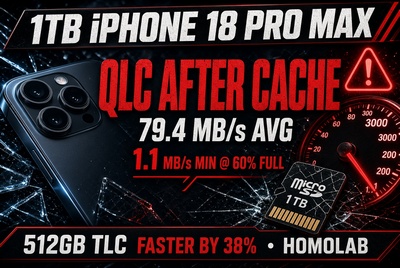 Bilibili lab HOMOLAB ran FIO storage tests on a 1TB iPhone 18 Pro Max and found its QLC flash can collapse after the fast cache fills. Writes start above 3,000 MB/s in the SLC cache, then fall to about 578 MB/s in a second buffer, then to an average of 79.4 MB/s - and as low as 25.6 MB/s - once the phone is writing straight to raw QLC. When the drive was about 60% full, that last stage averaged 45 MB/s and dipped to 1.1 MB/s, slower than many cheap microSD cards.
A 512GB iPhone 18 Pro using TLC beat the 1TB Pro Max in every mixed read/write test HOMOLAB published, by about 38% at light load and 12% under heavier load. Apple sells the 256GB Pro Max for $600 less than the 1TB model, and both 256GB and 512GB units are reported to use the faster TLC NAND. Everyday tasks still hit the burst cache, so the drop matters most for long 4K or ProRes recording, huge file copies, and backup restores. Apple has not published NAND types or commented on the results.
The problem comes down to the use of QLC flash memory for storage over
TLC. As the names imply, QLC can store four bits of data per memory
cell, while TLC stores three bits. Every time a single bit changes, all
four bits need to be rewritten with QLC SSD media.
With the creation of 3D NAND, TLC memory is considered a good choice if
you want to balance the speed of accessing stored data with capacity.
There's also durability to consider. Due to writing more bits to each
memory cell, QLC is both slower and less durable over time than TLC
memory.
To get around these limitations, Apple included a small cache of
single-level cell (SLC) SSD media, which handles brief write commands
and acts as a buffer with the main storage capacity. This cache is
extremely fast, in the region of 3,000MB/s, so long as it has available
room in its very small capacity.
Once this is exhausted, there's a second buffer of slower storage,
which does the same job. This memory operates at TLC speed levels,
around 578MB/s in tests, but it too can be exhausted.
Eventually, if both initial and secondary buffers are full, the data is
directly written to the storage. However, this is at the mentioned
glacial speed.
The testing also found that the amount of free space on the drive can
make things worse, too. With the drive at 60% capacity, the lower
amount of free space cuts into the fast cache capacity severely, from
about 250GB of SLC cache to nearer 58GB.
This also impacts the TLC buffer, cutting the speed down to 396MB/s.
With the buffers exhausted again, the QLC writing speed averages to
45MB/s, and occasionally hit a glacial 1.1MB/s.
|
|
last 10 comments: All comments
|
|
)
 Add your comment (free registration required)