 Updated:10:29 PM CEST Sep,06
(new)
Updated:10:29 PM CEST Sep,06
(new)

(c) 1998-2026 Gameguru Mania
Privacy Policy statement
|
C++ Creator: AI Code Is Buggier, Fatter, and Harder to Trust - briefly|
| (hx) 10:20 PM CEST - Sep,06 2026 | 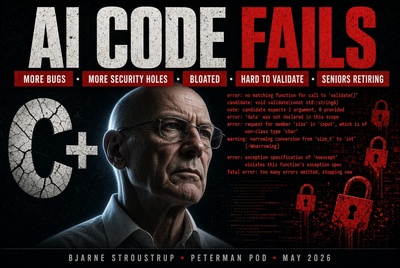 C++ creator Bjarne Stroustrup said the AI-generated code he has seen in programming-language work has not been successful.
On The Peterman Pod he said those tools produce more bugs, more security holes, and bloated programs that use extra memory and are hard to validate.
He added that some senior developers who would have to check that output are starting to retire rather than re-check code that changes every time a prompt changes.
Stroustrup said current AI is not good at safety-critical or performance-critical software - the 10–20% of the world’s code he cares about — even if 70–80% of code sits outside that bar.
He recalled Edsger Dijkstra calling the idea of using natural language as a programming language idiotic, and said English is too ambiguous for the precision engineering needs.
The remarks are from Ryan Peterman’s May 18, 2026 interview, now recirculating:
1:28:51 — AI writing code
Ryan:[1:28:51] When I look at the industry today, more and more code is being written by machines than by humans. I feel like a lot of programming language design is thinking about how to make it amenable to humans solving problems and writing the code. I’m curious if you have any thoughts on whether you think programming language design will change if more and more of the code is written by models and machines.
Bjarne: [1:29:23] I think that in the field I’m mostly interested in, code will still be written by humans, and they will use abstraction. The examples I’ve seen of attempts for AI to generate code in this domain have not been successful. They generate more bugs, more security holes. They have bloated code, which pessimize again because you use more memory, and it’s hard to validate. The senior developers that would be needed to validate it have started to retire because they don’t want to deal with the validation of something that changes every time you make a change in your code or your prompts. Furthermore, a lot of the things I think about involve regulatory bodies for this validation. You have to be able to validate what you changed. When you make a change and the AIs, the tools change, even if you make a slight difference in the prompt, a lot of the code will change, and you have to check it again.
[1:30:08] I’ve seen some of them starting to retire because they don’t want to deal with the validation of something that changes every time you make a change in your code, in your prompts. Furthermore, a lot of the things I think about involve regulatory bodies for this validation. You have to be able to validate what you changed. When you make a change and the AIs, the tools change, even if you make a slight difference in the prompt, a lot of the code will change, and you have to check it again.
[1:30:47] All of the code that was generated knows more code generated than if it was written by humans. When a human makes a change, it will make a change that’s localized. You can look for the effects of that localized change. If an AI writes it, you don’t actually know where it’s changed. You have to try and figure that out. So if you’re doing something that has been done many times before, like writing a standard web app, what you say is correct.
[1:31:22] Also, AI is not useless. That’s not what I’m saying. It can be used to write documentation. Again, it has to be humanly validated, but it helps write things. It’s good at text. It’s not, at least now, good at safety-critical, performance-critical code. Now, let’s say that 70 or 80% of the world’s code doesn’t fit that pattern. But it’s that 10 or 20% of the code that I’m interested in. And there, it’s not there.
[1:32:09] And I don’t see it coming with the LLM model. Furthermore, when fed with training data, it has to be trained with old code. My job, as I see it, is to make sure people write new things and use new techniques that are improvements over the old code. I find that LLM-based code is imitating old code and getting old performance and old bugs again. Maybe you can improve that. I hear rumors of Bjarne apps being written that fit my writings, but even that is problematic because I’m not saying exactly the same as I did 20 years ago.
[1:33:06] But anyway, we’ll see. Also, even Dijkstra was looking into the possibility, and he claimed that the idea of having natural languages as the programming language was idiotic. He’s less polite than I am. I think that a language like English is very flexible, and what we say is often very ambiguous. We need a programming language that’s precise, that’s engineering, that’s math; it’s not English.
transcript: https://www.developing.dev/p/creator-of-c-bell-labs-negative-overhead |
|
last 10 comments: All comments
|
|
)
 Add your comment (free registration required)